 Seattle Streets Alliance
The State of Automated Enforcement in Seattle
- gordon
- Sept. 2, 2026
School has begun! Now, school zone speed cameras across the city will turn on for a few hours each day, immediately around school start and end times, to protect kids walking and biking to and from school.
What are automated enforcement cameras, how do they differ from other cameras on our streets, and what’s happening?
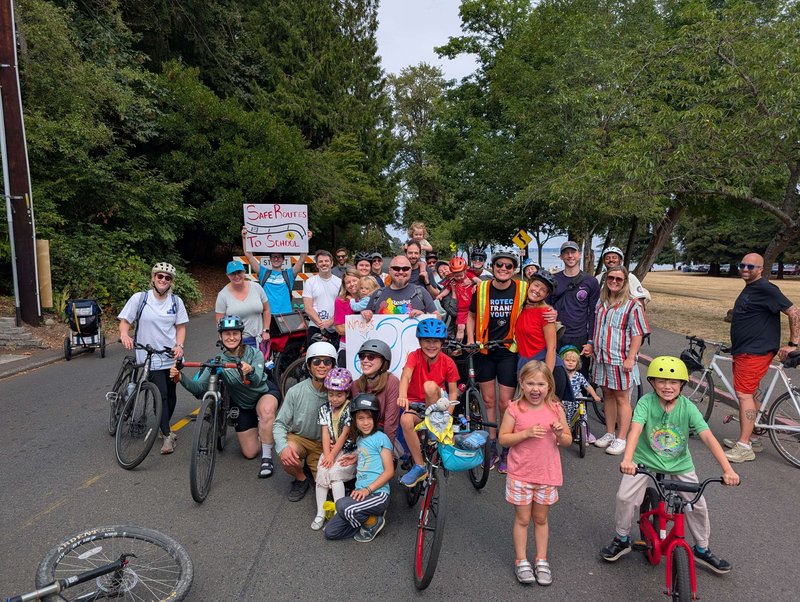
Ms Maddy, teacher at Graham Hill Elementary, leading a group bike ride in support of Safe Routes to School
What are automated speed enforcement cameras?
Seattle has used school zone speed cameras since 2012, and the program doubled in size after council action in 2024. Camera enforcement now covers 35 school zones across the city (with multiple cameras in most zones). Mayor Wilson also just announced the first 24/7 speed cameras, soon to be installed in 4 locations.
Despite the Trump administration recently wiping them from federal webpages, speed enforcement cameras are proven to decrease dangerous speeding, the top cause of injuries and deaths in traffic violence on our streets, and decrease collisions with people walking and biking by 50% where they are deployed.
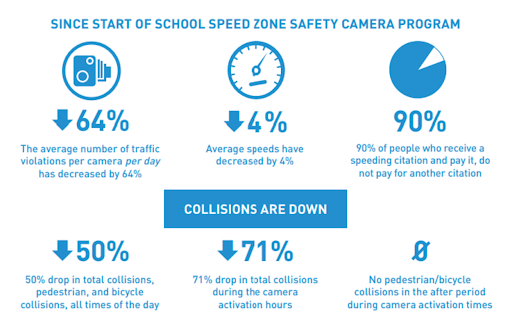
Speed cameras change behavior and make safer drivers. 90% of people who receive a citation from one do not get another one!
Speed cameras are a fairer and more equitable way to enforce speed limits. Compared to in-person policing, there is no risk of bias, harassment, or worse. Speed cameras are marked with signs where they exist and give 30 days of warnings when they are installed. For those who have trouble paying the fine, the program has reduced (by 50%) penalties for people receiving government assistance, and offers alternative community service and payment plans. However, we are still seeking additional policy reforms that will make them more equitable (see below for more details).
Automated enforcement cameras are useful and important safety tools in certain situations.
What are other automated enforcement cameras in Seattle?
In addition to school zone cameras, automated enforcement in Seattle also includes red light cameras, bus lane cameras, “block the box” cameras.
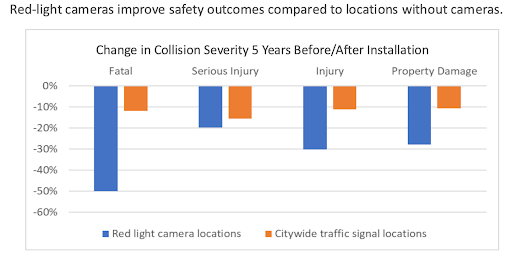
There are currently 30 locations in Seattle where you would get an automatic ticket for running a red light. Red light cameras are effective at reducing collisions related to red light running, and unfortunately there are few other tools to address this chronic issue.
How do they compare to CCTV and surveillance cameras on our streets?
Starting in 2025, Seattle police installed surveillance cameras on Seattle streets, launched the Real Time Crime Center (RTCC), and used them to enforce new exclusion zones and abduct people off our public streets. What are these technologies?
- Closed-Circuit Television Cameras (CCTV): Cameras that record videos of public streets and areas 24/7. They can see for a mile away and identify people at 600 ft (2 blocks). SPD saves footage for 30 days. These cameras are currently in use along Aurora Ave, in Belltown, Downtown, Central District, the CID, and other locations throughout the city.
- Automatic License Plate Readers (ALPR): Cameras mounted on all police vehicles that record license plates, bumper stickers, and other identifying features of any vehicle driving nearby. A new state law exempts ALPR data from public records requests, as was previously legal.
- Seattle Dept of Transportation traffic monitoring cameras: These cameras are significantly less powerful and lower resolution than CCTV cameras, and their live feeds have been used for years to monitor traffic on most major arterials in the city. The city now feeds footage into the real-time crime center (RTCC). The cameras are not clear enough to recognize individuals, but the RTCC can use them to track individuals identified by other, higher-resolution cameras.
Video footage and data from these three systems, as well as drone footage and private cameras in homes or businesses that opt into the system, are compiled by the Real-Time Crime Center (RTCC) into one live map for police surveillance. Seattle does not use Flock cameras; instead, it uses Axon, a similar company with the same problematic data-sharing features. All footage and data aggregated through the RTCC is accessible to all other Law Enforcement Agencies that use Axon, including ICE. It is currently used to enforce SODA and SOAP zones (areas that prohibit people suspected of crimes from entering the neighborhood), and a recent UW report shows that ICE has been using license plate reader data to track and abduct people in our area.
Automated traffic enforcement cameras, by contrast, do not present the same privacy and surveillance concerns. They do not collect and save data unless there is an infraction. The infraction information they do collect does not include faces of the driver or passenger. Data does not feed into SPD’s Real Time Crime Center (RTCC), is not aggregated in any way, is stored only for a limited time, and state law prohibits its use for other policing purposes.
Despite not being a part of this network of surveillance cameras, all cameras on public streets can evoke visceral fears associated with past abuses, loss of privacy, and over-policing, particularly in BIPOC communities.
How to improve the automated enforcement camera program policies
Whose Streets? Our Streets! has done extensive community engagement and research about automated enforcement in Seattle over the years. While the program has improved dramatically thanks to their advocacy, more work remains.
1) Make privacy protections clear and accessible
Automated traffic enforcement cameras already have strong privacy protections that distinguish them from surveillance technologies like CCTV and automatic license plate readers. Under state law, they can capture vehicles and license plates only when an infraction occurs, cannot photograph the faces of drivers or passengers, and cannot use the information they collect for unrelated law-enforcement purposes.
Seattle should make these protections—and the City's specific data-retention and deletion timelines—easy for the public to find and understand and not obscured by third-party vendors.
As automated enforcement expands, SDOT should publish a clear, centralized privacy policy explaining what each type of traffic-enforcement camera collects, who can access the information, how long different records are retained, when they are deleted, and the legal restrictions preventing the data from being used for other purposes.
These protections already make automated enforcement fundamentally different from Seattle's broader surveillance systems. Making them more visible and understandable can help maintain public trust as the program grows.
2) Try other solutions first
Punitive Ticketing is far less preferable than changing the physical street design to discourage speeding. Physical infrastructure like speed humps and stop signs slow down speeding drivers 24/7 without expensive operating costs, financial burdens, or surveillance concerns. SDOT has stated that “speed zone cameras are a tool [to] turn to after other engineering interventions have not resulted in slower speeds”, yet elected leaders have continually expanded our automated enforcement program over the last few years before other methods (like speed cushions, raised crosswalks, etc) are attempted.
3) Reduce the economic burden of fines
Fines in Seattle are unnecessarily high, with limited reasonable alternatives for people who are unable to pay. Unpaid tickets collect fines and can be sent to collections.
- Ticket Cost: Programs across the country have found that $50 fines discourage drivers from getting a second ticket at rates similar to our $237 fines. Lower fines are also significantly more likely to be paid and less likely to result in court action; they could be increased based on the severity of the violation, for repeat offenders, or through a future system with tiered fines based on income or ability to pay. If we can achieve the same safety benefits while lowering the inequitable economic impacts, why wouldn't we?
- Warnings: SDOT’s own data shows that warnings are 95% effective at preventing second violations. Currently, newly installed cameras issue warnings for the first 30 days, but warnings should be issued to all first-time offenders.
- Alternative Payment Options: Currently, people are expected to complete 14 hrs of community service if they cannot pay a fine. We must expand alternative payment options, make them accessible and automatic, and increase the wage paid for community service to a living wage.
- Reinvest all revenue in traffic safety: Revenue generated by unsafe driving should be used to make our streets safer.
Seattle has made progress toward this goal by directing most automated traffic-camera revenue toward safety investments. However, red-light cameras remain an important exception: a portion of the revenue they generate still goes into the City’s General Fund rather than being dedicated to transportation safety.
That distinction matters. Red-light cameras exist to address a specific safety problem—people driving through red lights and putting others at risk. The money generated by those violations should therefore be reinvested in solutions that address the same problem: safer intersections, redesigned streets, better crossings, traffic calming, and other improvements that reduce dangerous driving.
Keeping camera revenue connected to safety also helps protect public trust. Automated enforcement should never be viewed as a way to generate money for unrelated City services. Ideally, a successful camera program should result in fewer violations, fewer tickets, and eventually less revenue because people are driving more safely.
Seattle should dedicate all net automated-enforcement revenue—including revenue from red-light cameras—to traffic-safety and accessibility improvements.
Other cities provide a model. For instance, San Francisco directs net revenue from its speed-camera program back into street safety improvements.
The purpose of automated enforcement should be safer streets, not a revenue stream for the general fund.
What’s currently happening with automated enforcement?
Last year, the City Council approved a new 24/7 speed enforcement program, and Mayor Wilson recently announced she will install and evaluate the first 4 cameras.
Because these cameras will operate 24/7, they could reduce dangerous speeding throughout the day and make streets safer for everyone walking, biking, rolling, and driving. At the same time, expanded enforcement will likely result in significantly more tickets than school-zone cameras currently issue, making it even more important for the City to address the program's existing inequities and financial burdens. As Seattle expands automated enforcement, we should make sure the program maximizes its safety benefits while minimizing unnecessary harm.
Safer streets and a better program
Automated enforcement cameras can be an important part of making Seattle’s streets safer. They can reduce dangerous speeding, change driver behavior, and enforce traffic laws without relying on in-person police stops.
But supporting automated enforcement doesn’t mean the program can’t be improved.
As Seattle expands its use of speed cameras, the City has an opportunity to build a program that is safer, fairer, and more transparent. That means prioritizing street design that prevents dangerous driving in the first place, reducing the financial burden of tickets, protecting people’s privacy, and reinvesting revenue into physical safety improvements.
Ultimately, the goal isn’t to issue more tickets. The goal is to create streets where fewer people are driving dangerously in the first place.
Automated enforcement can help us get there—but it should be one tool among many as Seattle works toward streets that are safe and welcoming for everyone.